The Last Porch Light – Chilling Stories for Dark Nights
Last updated: February 28, 2026
Quick Teaser
When every house on Maple Street goes dark at once, only one porch light keeps burning. The neighbors won’t talk about it. The old-timers won’t even look at it. And at midnight, something in the dark starts testing the edges of that light—learning where it can’t go, waiting for the moment it finally can. If you’re looking for chilling stories for dark nights, this one will make you check your own porch before bed.
Reader Note: This is a work of fiction.
The Street That Forgot How to Glow
The power went out three blocks from home.
Not flickering. Not brownout. Just gone.
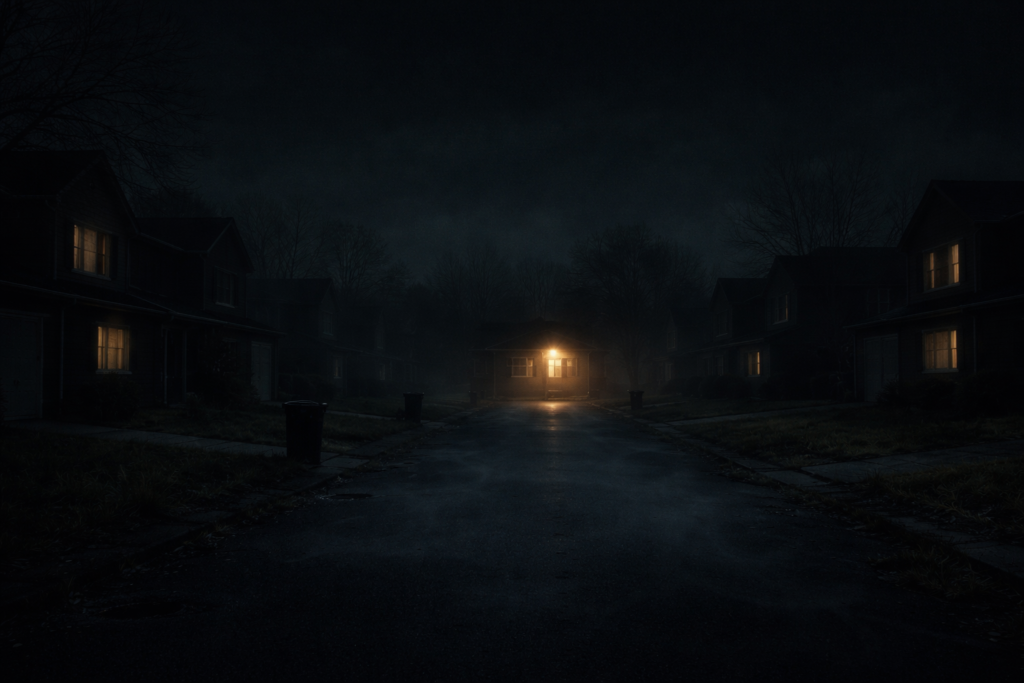
Casey’s headlights swept across Maple Street, and the darkness looked wrong. Too complete. No blue glow from TVs bleeding through curtains. No porch lights left on by habit. No streetlamps humming their orange buzz.
Just black houses under a moonless sky.
The car’s dashboard clock read 11:47 PM. Late shift at the hospital always ran over. Casey’s mind still buzzed with the fluorescent overload of the ER, the constant beeping, the controlled chaos. Coming home to silence should have felt like relief.
It didn’t.
The engine cut off. The headlights died.
And that’s when Casey noticed it.
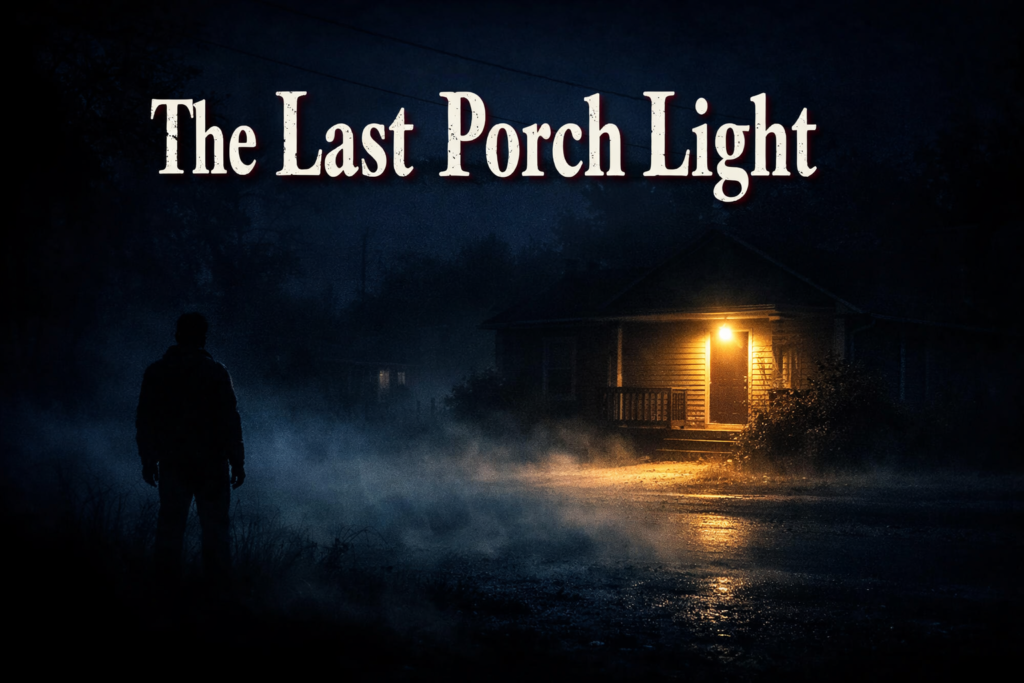
At the end of the block, where the Ashford house sat—had sat empty for months, or was it years?—a single porch light burned steady and bright.
Warm. Yellow. Impossibly alone.
Casey sat in the dark car and stared at it. The light didn’t flicker. Didn’t dim. It just… waited.
No crickets chirped. No distant traffic hummed. Even the wind had stopped.
The whole street held its breath.
The Rule Nobody Explains Out Loud
Casey’s phone buzzed. A text from Marissa next door.
“You home?”
“Yeah. Just pulled in. Power out for you too?”
Three dots appeared. Disappeared. Appeared again.
“Don’t go near the light.”
Casey’s thumbs hovered over the screen.
“What light?”
“You know which one. Just don’t. Please.”
The text felt cold. Marissa didn’t do cryptic. She did book club and casseroles and waving from her garden. This was different.
Casey glanced up. Across the street, a curtain moved in the Hendersons’ front window. Just a twitch. Then stillness.
Two houses down, another curtain shifted.
They were all watching.
Not the street. Not Casey’s car.
The porch light.
Casey typed back: “Why? What happens?”
The response came fast.
“Old rule. If it goes out, something comes closer. Nobody talks about it. Nobody goes near it. Just… go inside. Lock your door. It’ll be morning soon.”
The message ended there.
Casey looked at the light again. It seemed brighter now. Or maybe everything else had gotten darker.
The Last Light Doesn’t Flicker
Curiosity is a patient thing. It waits until logic gets tired.
Casey stepped out of the car.
The air felt different. Heavier. Like walking into a walk-in freezer, but without the cold—just the weight, the pressure, the sense of crossing into somewhere else.
Footsteps echoed too loud on the pavement. Each step sounded like it traveled farther than it should, bouncing off nothing and returning changed.
The porch light was maybe fifty yards away.
Casey walked toward it.
Thirty yards.
The temperature dropped. Not gradually. All at once, like stepping through an invisible curtain. Breath misted in the air. The hospital scrubs felt thin.
Twenty yards.
Sound muffled. Not silent—muffled. Like someone had wrapped the world in cotton. Casey’s heartbeat became the loudest thing in the universe.
Ten yards.
The light pulsed.
Just once. So subtle it could’ve been a blink, a trick of tired eyes.
But Casey saw it.
And when Casey looked away—just a glance back toward the car, a split-second check on the distance traveled—the light seemed brighter when eyes returned to it.
Like it had moved closer.
Or leaned in.
The Porch That Feels Like a Border
The Ashford house looked normal.
That was the worst part.
Peeling white paint. Sagging gutter on the left side. A mailbox with faded numbers. The kind of house that blends into every American suburb, forgettable and familiar.
But it was too still.
No settling creaks. No wind rattling loose siding. It sat there like a photograph, like something held in place by will instead of nails.
The porch light cast a perfect circle on the wooden planks below. Sharp-edged. Geometric. The boundary between light and shadow didn’t fade—it cut.
Beyond that line, the darkness looked thick.
Not absence-of-light dark. Substance dark. The kind that might push back if you touched it.
Casey stopped at the edge of the light’s reach. Toes just inside the circle.
The air inside the light felt warmer. Safer. Like standing near a campfire while wolves circled just beyond the flames.
And then Casey saw it.
Movement in the dark.
Not a shape. Not a figure. Just… movement. The way darkness shifts when something passes through it. The way water ripples around a submerged object you can’t quite see.
It moved along the edge of the light. Testing.
Casey’s breath caught.
The movement stopped.
Then continued. Slower. More deliberate.
Learning.
Midnight Learns Your Name
Casey’s phone buzzed. The sudden vibration felt like a scream.
The clock read 12:00 AM.
Exactly.
The porch light pulsed again. Longer this time. A full second of dimming before it surged back to brightness.
And then Casey heard it.
A whisper.
Soft. Close. Right behind the left ear.
“Casey.”
Not a question. A statement. Like someone confirming attendance on a list.
Casey spun around.
Nothing.
The street stretched empty and dark behind. The car sat abandoned thirty yards back, looking small and useless.
“Casey.”
This time from the porch.
Casey’s head snapped forward.
The front door of the Ashford house was closed. Had been closed. Was still closed.
But the whisper had come from inside.
And then—impossibly—from the darkness beyond the light at the same time.
Two voices. Same word. Same tone. Stereo.
Casey’s childhood nickname followed, the one only family used, the one nobody on this street should know.
“Case-case.”
The darkness pressed closer to the light’s edge. The boundary held, but barely. Like surface tension on water about to break.
The Bulb Isn’t the Source
Casey stumbled backward, foot hitting something solid.
The porch step.
Hands caught the railing for balance. The wood felt warm. Warmer than it should be on a night this cold.
That’s when Casey saw the carving.
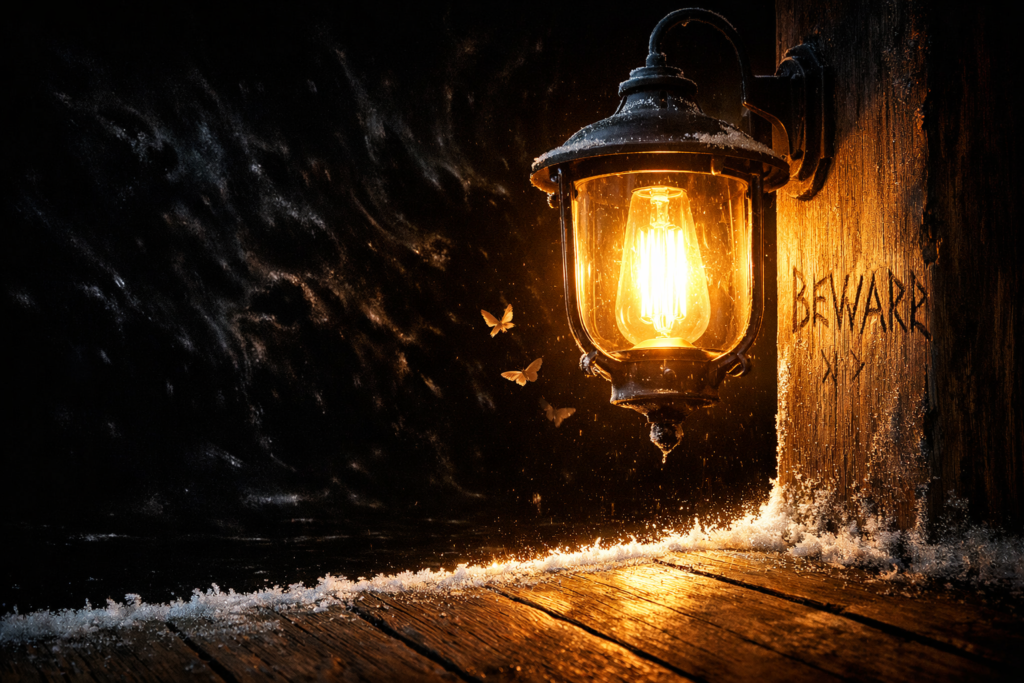
Scratched into the porch post, hidden from the street, visible only from this angle: words gouged deep into the wood by something sharp and desperate.
“The light is not the bulb. The bulb is not the light. Keep it burning. Don’t let it see you leave.”
Below that, a date. Eleven months ago.
Below that, initials. D.A.
David Ashford. The previous owner. The one who’d disappeared.
Casey looked up at the porch light. The bulb was old—ancient, even. One of those vintage Edison bulbs with visible filaments, the kind that should’ve burned out years ago.
But it wasn’t flickering. Wasn’t dimming.
Because it wasn’t actually burning.
The light came from somewhere else. The bulb was just… the opening. The valve. The place where something else poured through.
A seal.
And seals only work if someone maintains them.
Casey’s stomach dropped.
The darkness beyond the light shifted again. Closer. More shapes now. Suggestions of limbs, of faces, of things that had once been human and had forgotten how.
They couldn’t cross the light.
But they were waiting.
The Thing That Waits Outside the Warmth
The light dimmed.
Not a pulse this time. A slow fade. Like a battery dying. Like something giving up.
The circle of illumination on the porch shrank. Six feet across. Five. Four and a half.
The darkness rushed in to fill the gap.
Casey pressed back against the front door. The wood felt hollow. Empty. Like the house behind it had been scooped out, leaving only walls and the memory of rooms.
The shapes in the dark grew clearer.
Tall. Thin. Wrong proportions. Arms too long. Heads tilted at angles that necks shouldn’t allow.
They didn’t have faces.
They had the places where faces should be.
And they were patient.
One of them reached toward the light. A hand—if it was a hand—stretched out, fingers extending like smoke, testing the barrier.
Where it touched the edge of the light, the air hissed. Not with heat. With something else. Resistance. Rejection.
The hand pulled back.
But the light dimmed another inch.
Casey understood.
The seal wasn’t breaking.
It was exhausting.
And when it finally gave out, the things in the dark wouldn’t need to test anymore.
They’d simply step through.
The Choice the Light Demands
Casey’s hand found the doorknob.
Locked.
Of course it was locked. The house was empty. Abandoned. Nobody lived here.
Nobody except the light.
Casey’s eyes scanned the porch. There had to be something. A switch. A backup. A way to—
There.
Beneath the mailbox, a small metal panel. Painted over. Almost invisible.
Casey’s fingers pried at the edge. Nails bent. Skin tore. The panel popped open.
Inside: a switch. Old. Rusted. And below it, a handwritten note on yellowed paper.
“Flip it. Speak the words on the post. Don’t run. It has to see you stay.”
The words on the post. The carving.
Casey’s voice shook.
“The light is not the bulb.”
The switch flipped up with a heavy click.
“The bulb is not the light.”
The porch light surged. Brightness exploded outward, pushing the darkness back ten feet, twenty, across the yard and into the street.
The shapes recoiled. Silent. Furious.
“Keep it burning.”
The light steadied. Stronger now. Fed.
“Don’t let it see you leave.”
Casey’s hand stayed on the switch.
And something changed.
A warmth spread up Casey’s arm. Not painful. Not pleasant. Just… present. Like a mark. Like a signature on a contract nobody had read.
The light knew.
Casey was the keeper now.
The Last Porch Light
The darkness retreated to the edges of the yard. Waiting. Always waiting.
Casey stood on the porch for another ten minutes. Or an hour. Time felt negotiable here.
When the light finally stabilized—burning steady, no longer fading—Casey stepped back.
Slowly.
Watching the darkness. Making sure it saw. Making sure it understood.
The things beyond the light didn’t move. They just watched back.
Casey walked to the car. Got in. Started the engine.
The porch light burned behind, reflected in the rearview mirror.
The Ashford house sat empty.
No David Ashford. No previous keeper.
Just a light that couldn’t go out.
And someone who’d made sure it didn’t.
Casey drove the thirty yards home. Parked. Walked to the front door.
The house was dark. Power still out.
Casey’s hand reached for the doorknob.
And then—
Click.
The porch light turned on.
Not the switch. Casey hadn’t touched the switch.
It just… turned on.
Warm. Yellow. Steady.
Exactly like the one at the end of the block.
Afterglow
Casey stood in the doorway and stared at the light.
At the new light.
The second light.
Because that’s how it works, isn’t it?
One light keeps the darkness back. But the keeper needs a light too. Protection. A marker. A way for the next person to find them when the time comes.
Casey looked down the street.
The Ashford house porch light still burned.
And now, so did this one.
Two lights on a street that should have none.
Casey stepped inside. Locked the door. Walked to the kitchen window and looked out at the backyard.
The yard was dark.
For now.
But in the distance, past the fence, past the tree line, something moved in the shadows.
Testing.
Learning.
Waiting for the next midnight.
Casey’s phone buzzed one last time. A text from an unknown number.
“Welcome, keeper. The light is not the bulb. The bulb is not the light.”
And below that, a list.
Names. Dozens of them. Addresses. Dates.
Every keeper who’d come before.
Every light still burning.
Every person standing watch in the dark.
The last entry was new.
Casey Mitchell. 428 Maple Street. March 1, 2026.
Casey’s hands shook.
Outside, the porch light burned steady.
And in the darkness beyond, something whispered a name it had just learned.
Waiting for the night it would finally cross.
Related Reading
Looking for more chilling stories for dark nights? Visit our collection of Chilling Stories for Dark Nights for tales that will keep you up long after the lights go out.
Explore our complete Horror Stories section for more spine-tingling fiction.
For even more atmospheric terror, check out our Spine Chilling Stories archive.
Conclusion
“The Last Porch Light” is one of those chilling stories for dark nights that lingers long after the final line. It reminds us that some responsibilities choose us, that some lights must never go out, and that the darkness is always patient.
The best horror doesn’t rely on gore or jump scares. It builds dread through atmosphere, through the small details that feel wrong, through the quiet realization that something has changed and there’s no going back.
If this story made you check your own porch light, it did its job.
And if you’re wondering whether your light is protecting you or marking you… well, that’s the question every keeper has to answer eventually.
Next steps for dark night story lovers:
Bookmark our chilling stories collection for your next late-night read. Share this story with someone who appreciates slow-burn horror. And maybe—just maybe—leave your porch light on tonight.
Some lights are meant to burn.